Mainland vs Special Economic Zones (SEZs) in Saudi Arabia: Complete Investment Guide
Introduction
Saudi Arabia's Special Economic Zones offer compelling investment opportunities emerging from Vision 2030's economic transformation. The Kingdom's making serious moves here—targeting 12 trillion SAR in local and foreign investment by 2030, with SEZs positioned right at the centre of that ambition. These zones are actively developing infrastructure and rolling out new projects, whilst they've already attracted substantial foreign investment and created thousands of jobs across strategic sectors. For businesses evaluating Middle East expansion, SEZs offer tax efficiency, operational flexibility, and market access that's difficult to match regionally.
The value proposition? 5% corporate tax instead of 20% mainland rates (or 0% in select zones), complete foreign ownership without local sponsors, and employment flexibility that mainland operations can't provide. Add zero withholding tax on profit repatriation, VAT exemptions on intra-zone transactions, customs duty relief, plus exemptions from operational fees for employees and their families—substantial savings compounding over years.
This guide analyses what SEZs actually offer, which zone suits different business models, how they compare to mainland setup, and why investors combine SEZ operations with the Regional Headquarters programme for optimal tax efficiency.

Tax Optimisation
Reduce corporate tax from 20% mainland to 5% in standard SEZs—or 0% for 50 years in SILZ. Zero withholding tax on profit repatriation and 0% VAT on intra-zone transactions deliver compounding savings.
Complete Foreign Ownership
100% foreign ownership guaranteed across all activities in SEZs, eliminating local sponsor requirements that restrict many mainland sectors and providing full operational control.
Employment Flexibility
0% Saudisation for first five years, then 15% in years six through ten. Mainland requires 25-33% from day one. Expat levy fully exempted, saving SAR 400 monthly per foreign employee.
Strategic Infrastructure
Purpose-built zones with ports, airports, and industrial facilities. KAEC offers established manufacturing ecosystems, SILZ provides two-hour customs clearance, NEOM delivers 100% renewable energy.
ECZA One-Stop-Shop
Streamlined licensing through Economic Cities and Special Zones Authority's centralised service platform. Single coordination point replaces multi-agency navigation, expediting approvals and ongoing support.
Enhanced Protections
Updated investment framework strengthens safeguards for foreign investors, clarifies dispute resolution mechanisms, and ensures unrestricted profit repatriation with strong legal protections.
Proven Track Record
Saudi Arabia's Special Economic Zones have attracted substantial foreign investment whilst creating thousands of jobs across strategic sectors.


Understanding Special Economic Zones in Saudi Arabia
Special Economic Zones are designated geographic areas offering exceptional tax incentives, regulatory frameworks, and business benefits that attract foreign investment and drive economic diversification. Unlike traditional mainland operations, SEZs provide comprehensive packages of financial advantages, operational flexibility, and streamlined administrative processes through dedicated governance structures.
Saudi Arabia established its SEZ framework as a cornerstone of Vision 2030's economic transformation strategy. The Kingdom recognised that achieving ambitious diversification goals required creating competitive investment destinations capable of attracting global capital, advanced manufacturing, new technologies, and specialised industries. SEZs address this imperative by offering incentives that rival or exceed regional alternatives whilst leveraging Saudi Arabia's strategic location, substantial domestic market, and government-backed infrastructure investments.
The Economic Cities and Special Zones Authority (ECZA) governs all SEZ operations, providing centralised One-Stop-Shop services that streamline licensing, approvals, and ongoing investor support. This unified approach eliminates the complexity of navigating multiple government agencies, expediting establishment timelines and simplifying compliance requirements. Recent legislative enhancements have strengthened investor protections, clarified dispute resolution mechanisms, and reinforced Saudi Arabia's commitment to creating a transparent, predictable business environment for international investors.
All business establishments require registration with the relevant Saudi authorities. ECZA handles SEZ registrations through its One-Stop-Shop, whilst MISA coordinates mainland establishment—both offering streamlined processes designed to get you operational quickly.
Special Economic Zones at a Glance
Saudi Arabia operates six operational SEZs, each designed for specific industries and strategic objectives. Identifying which zone aligns with your business model is the critical first step in optimising your Saudi Arabian investment strategy.
KAEC
- Focus: Manufacturing & Logistics
- Location: Makkah Province, 100km north of Jeddah
- Key Benefit: World-class port infrastructure with established industrial ecosystem hosting over 100 multinational companies
- Tax: 5% corporate tax for 20 years Learn more about KAEC
NEOM
- Focus: Innovation & Sustainability
- Location: Red Sea coast, Tabuk Province
- Key Benefit: 100% renewable energy mandate with advanced smart city infrastructure supporting future technologies
- Tax: 5% corporate tax for 20 years Explore NEOM
SILZ
- Focus: Logistics & E-commerce
- Location: King Khalid Airport, Riyadh
- Key Benefit: Unprecedented 0% corporate tax for 50 years on qualifying logistics operations with sub-two-hour customs clearance
- Tax: 0% for 50 years SILZ details via ECZA
Jazan
- Focus: Food Processing & Industry
- Location: Jazan Province, Southwest Saudi Arabia
- Key Benefit: Strategic Red Sea location with LEED Platinum certified infrastructure, southern gateway to regional markets
- Tax: 5% corporate tax for 20 years
Ras Al-Khair
- Focus: Maritime & Shipbuilding
- Location: Eastern Province, Arabian Gulf
- Key Benefit: Largest maritime yard in MENA region with comprehensive shipbuilding facilities and deep-water port access
- Tax: 5% corporate tax for 20 years
Cloud Computing SEZ
- Focus: Data Centres & Cloud Services
- Location: Virtual zone (operate anywhere in Kingdom), based at King Abdulaziz City for Science and Technology
- Key Benefit: Supports digital transformation with sector-specific incentives whilst allowing establishment anywhere in Saudi Arabia. The innovation tower serves as a strategic hub for cloud providers with advanced infrastructure centred at King Abdulaziz City.
- Tax: 5% corporate tax for 20 years
Mainland vs SEZ in Saudi Arabia: Strategic Comparison for Investment Decisions
Understanding the fundamental differences between mainland operations and Special Economic Zones is the cornerstone of effective Saudi Arabian investment planning. This comparison directly impacts your taxation structure, ownership arrangements, employment obligations, operational costs, and market access strategy. The table below provides a side-by-side analysis of critical factors affecting your investment decision.
Tax treatment shows the starkest difference. Mainland operations benefit from established infrastructure with 20% corporate tax, whilst SEZs offer substantially reduced rates of 5% for 20 years—or exceptional 0% rates for 50 years in SILZ. These savings compound significantly over time, creating substantial financial advantages for qualifying operations.
Ownership structures differ notably. Many mainland sectors require local partners or have foreign ownership restrictions, whilst SEZs guarantee 100% foreign ownership across all permitted activities without local sponsor requirements.
Employment obligations vary dramatically. Mainland operations face immediate Saudisation requirements of 25-33% from day one. SEZs provide significant flexibility with 0% requirements for the first five years, transitioning to 15% in years six through ten. The expat levy exemption in SEZs delivers additional cost savings, making payroll services significantly more cost-effective for businesses employing substantial expatriate workforces.
| Factor | Mainland Saudi Arabia | Special Economic Zones | Advantage |
|---|---|---|---|
| Corporate Tax | 20% standard rate | 5% for 20 years (0% SILZ for 50 years) | SEZ |
| Withholding Tax | Standard rates apply | 0% on profit repatriation | SEZ |
| VAT | 15% | 0% on intra-zone transactions | SEZ |
| Customs Duties | Standard rates | 0% deferral or exemption | SEZ |
| Foreign Ownership | Sector-dependent, often restricted | 100% permitted | SEZ |
| Saudisation Years 1-5 | 25-33% requirement | 0% requirement | SEZ |
| Saudisation Years 6-10 | 25-33% requirement | 15% minimum | SEZ |
| Expat Levy | SAR 400/month per employee | Fully exempted | SEZ |
| Domestic Market Access | Full and immediate | Limited (requires customs clearance) | Mainland |
| Setup Costs | Lower initial investment | Higher (zone fees and infrastructure) | Mainland |
| Processing Time | 5-7 working days via MISA with [GRO services] (https://tascoutsourcing.sa/en/services/government-relations-officer-in-saudi-arabia) | Expedited through ECZA One-Stop-Shop | SEZ |
| Minimum Capital | Sector-specific requirements | Flexible (SILZ: none required) | SEZ |
| Regulatory Body | MISA and Ministry of Commerce | ECZA centralized services | SEZ |
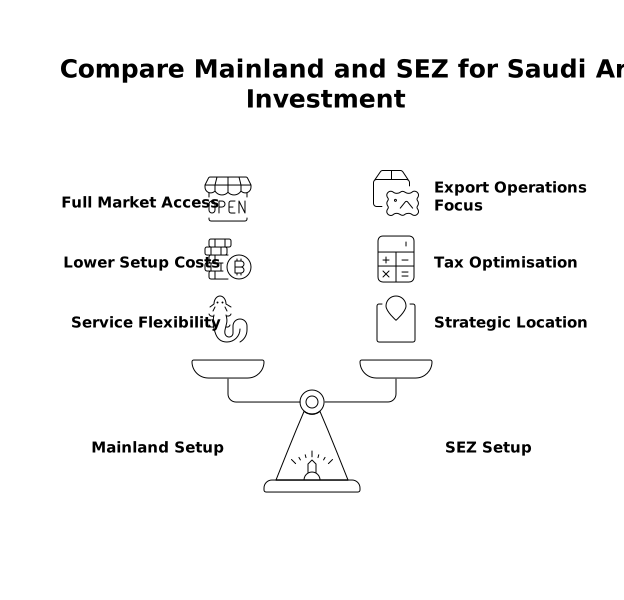
Choose Mainland if you need direct domestic market access, operate services across multiple cities, prioritise lower initial costs, or benefit from local partnerships.
Choose SEZ if you run export-focused operations, prioritise tax optimisation, need 100% foreign ownership, require employment flexibility, or want ECZA's One-Stop-Shop streamlining.
Hybrid strategy: Manufacturing in SEZs for tax advantages, paired with mainland sales offices for domestic market access.
Tax Savings Comparison
Over a 10-year period, standard SEZs deliver 75% tax savings compared to mainland rates through the reduced 5% corporate tax. SILZ offers complete tax exemption for qualifying logistics operations—eliminating corporate tax entirely for 50 years.



Ready to Evaluate Your SEZ Options?
Choosing between mainland and SEZ setup requires careful analysis of your business model, tax optimisation priorities, and market access needs. Our experts help you make the right decision and structure your Saudi Arabian operations for maximum efficiency.
Mainland Saudi Arabia Setup
Mainland establishment provides comprehensive access to Saudi Arabia's domestic market with immediate operational flexibility across all cities and regions. This traditional approach suits businesses prioritising direct market access over tax optimisation, particularly service providers, retailers, and companies targeting Saudi consumers.
Mainland operations benefit from established commercial infrastructure, proven regulatory frameworks, and straightforward market access without customs clearance requirements. The 20% corporate tax rate applies alongside full business registration through MISA, providing complete integration with Saudi Arabia's economic mainstream.
Foreign ownership varies by sector, with many industries now permitting 100% foreign ownership whilst others require local partnerships. Employment requirements include immediate Saudisation obligations of 25-33% from day one, reflecting the Kingdom's commitment to workforce development. Processing through MISA typically completes within 5-7 working days with proper documentation and GRO services.
Choose mainland establishment when your business model depends on direct domestic sales, requires service delivery across multiple cities, benefits from local partnerships, or prioritises lower initial setup costs over long-term tax advantages. Many investors pursue hybrid strategies combining mainland sales offices with SEZ manufacturing or logistics operations.
Individual Special Economic Zone Profiles
Each zone has specific strengths that align with different business requirements. The following profiles examine location advantages, target industries, infrastructure capabilities, and ideal business fits for Saudi Arabia's six operational SEZs.
King Abdullah Economic City (KAEC): Manufacturing Hub in Saudi Arabia's SEZ Network
King Abdullah Economic City spans 185 square kilometres in Makkah Province, 100km north of Jeddah. As Saudi Arabia's most established SEZ, KAEC combines world-class port infrastructure with manufacturing facilities—the Kingdom's premier hub for manufacturing and logistics operations.
Location & Infrastructure: King Abdullah Port provides exceptional efficiency with Red Sea access serving global trade routes. The zone offers industrial land with purpose-built facilities, utilities, integrated warehousing, and direct motorway connectivity to Jeddah. Over 100 multinational companies operate within KAEC, creating supply chain advantages unavailable in greenfield locations.
Target Industries: Automotive supply chain and assembly, consumer goods manufacturing, assembly consumer goods ICT, pharmaceuticals and medical technology, industrial equipment, and integrated logistics operations requiring smooth integration between imports, manufacturing, and exports.
Tax Benefits: 5% corporate tax for 20 years, 0% withholding tax on repatriation, 0% VAT intra-zone, 100% foreign ownership, 0% Saudisation first five years (15% years six through ten), and customs duty exemptions.
Best For: Manufacturing requiring port access, automotive and consumer goods producers, companies targeting Middle East-Africa exports, businesses needing Jeddah proximity, and organisations prioritising established infrastructure with proven operational track records over greenfield development.
NEOM: Future-Focused SEZ in KSA for Sustainable Innovation
NEOM spans 26,500 square kilometres on Saudi Arabia's Red Sea coast in Tabuk Province. Focused on innovation, sustainability, and advanced technologies, NEOM positions Saudi Arabia at the forefront of future-economy development with environmental commitments unmatched in the region.
Location & Infrastructure: NEOM delivers 100% renewable energy infrastructure with substantial planned capacity. Integrated smart city technology, planned international airports and seaports, and dedicated industrial zones within OXAGON support sustainable manufacturing. Development spans The Line, OXAGON, Sindalah resort, and Trojena, creating opportunities across phased timelines.
Target Industries: Renewable energy and green technology, advanced sustainable manufacturing, biotechnology and life sciences, artificial intelligence and digital infrastructure, sustainable tourism and luxury hospitality, clean food production, and circular economy businesses. Companies with genuine environmental credentials and technological innovation receive priority.
Tax Benefits: 5% corporate tax for 20 years, 0% withholding tax, 0% VAT intra-zone, 100% foreign ownership, 0% Saudisation first five years (15% years six through ten), and customs exemptions. NEOM's dedicated arbitration centres provide enhanced dispute resolution for international investors.
Best For: Sustainability-focused businesses with environmental credentials, technology innovators in AI-biotech-cleantech, renewable energy companies, businesses seeking smart city integration, organisations prioritising environmental commitments alongside tax efficiency, and companies comfortable with phased development timelines.
Special Integrated Logistics Zone (SILZ): Best Tax Benefits Among Saudi Arabia's SEZs
The Special Integrated Logistics Zone (SILZ) encompasses 32 million square feet at King Khalid International Airport in Riyadh. SILZ offers the Kingdom's most exceptional tax package: 0% corporate income tax for 50 years on qualifying logistics activities—complete tax exemption for half a century.
Location & Infrastructure: Direct integration with King Khalid International Airport provides immediate air cargo access. Multi-modal transport links and advanced customs technology enable e-parcel clearance under two hours. Temperature-controlled facilities suit pharmaceuticals and food, whilst dedicated e-commerce zones and comprehensive warehousing support diverse operations. Strategic positioning at Asia-Europe-Africa crossroads creates exceptional regional connectivity.
Target Industries: E-commerce fulfilment and cross-border logistics, freight forwarding, warehousing and inventory management, light assembly and packaging, regional distribution centres, express parcel services, and supply chain management requiring rapid customs clearance and air cargo integration.
Tax Benefits: 0% corporate tax for 50 years on qualifying logistics, 0% withholding tax, 0% VAT intra-zone, 100% foreign ownership, 0% Saudisation first five years (15% years six through ten), customs duty suspensions, and no minimum capital requirements.
Best For: Logistics operations prioritising maximum tax efficiency, e-commerce businesses serving GCC-MENA markets, companies requiring sub-two-hour customs clearance, regional distribution strategies, and organisations requiring air cargo connectivity for time-sensitive operations.
Jazan Economic City: Strategic SEZ in Saudi Arabia's Southern Region
Jazan Economic City occupies 24.6 square kilometres in Southwest Saudi Arabia's Jazan Province on the Red Sea coast. Positioned as the Kingdom's southern gateway, Jazan combines industrial port infrastructure with agricultural access, creating opportunities for food processing, metal manufacturing, and industrial operations targeting East African markets.
Location & Infrastructure: Industrial port providing Red Sea access to global trade routes, purpose-built industrial zones with comprehensive utilities, cold chain infrastructure for food processing, growing logistics and warehousing capabilities, and LEED Platinum sustainability certification. Ongoing investment programmes enhance competitiveness for industrial and agricultural businesses.
Target Industries: Food processing and agricultural value-added production, metal conversion and manufacturing, logistics and distribution, general industrial production, and export-oriented manufacturing. The zone attracts businesses leveraging Saudi agricultural capacity and targeting East African markets.
Tax Benefits: 5% corporate tax for 20 years, 0% withholding tax, 0% VAT intra-zone, 100% foreign ownership, 0% Saudisation first five years (15% years six through ten), and customs exemptions.
Best For: Food processing and agricultural businesses, metal and industrial manufacturers, companies targeting East African markets, businesses requiring cost-effective operational bases with port access, and organisations seeking greenfield development opportunities.
Need Help Selecting the Right SEZ for Your Business?
Each SEZ offers distinct advantages for specific industries and business models. Our team provides analysis of which zone aligns with your strategic objectives, tax optimisation goals, and operational requirements.
Specialised SEZs: Sector-Specific Opportunities
Beyond the four flagship zones, Saudi Arabia offers two specialised SEZs targeting niche sectors with unique infrastructure requirements.
Ras Al-Khair: Maritime Industries and Shipbuilding Hub
Ras Al-Khair is a specialised SEZ in Eastern Province focusing exclusively on maritime and offshore industries. Home to the King Salman International Complex—the MENA region's largest maritime yard—the zone serves Gulf maritime sectors with strategic partnerships.
Target Industries: Shipbuilding and vessel construction, maritime maintenance and repair, offshore rig fabrication, MRO rig platforms, and maritime equipment manufacturing.
Infrastructure: King Salman International Complex with shipbuilding facilities, deep-water port for large vessel access, and Arabian Gulf connectivity.
Tax Benefits: 5% corporate tax for 20 years, 0% withholding tax, 0% VAT intra-zone, 100% foreign ownership, 0% Saudisation first five years, and customs exemptions on materials.
Best For: Maritime construction and repair operations, offshore service providers, shipbuilders, and maritime equipment manufacturers serving the Gulf region.
Cloud Computing SEZ: Virtual Digital Infrastructure Hub
Cloud Computing SEZ is a virtual zone allowing businesses to establish anywhere in the Kingdom whilst accessing full SEZ benefits. Located within King Abdulaziz City for Science and Technology in Riyadh, this SEZ supports Saudi Arabia's digital transformation and Cloud First Policy with data sovereignty frameworks.
Target Industries: Data centres, cloud infrastructure, AI and machine learning platforms, SaaS and PaaS providers, and digital transformation services.
Infrastructure: Virtual model enables establishment anywhere in Saudi Arabia with complete SEZ benefits—flexibility that geographically fixed zones can't match. The innovation tower within King Abdulaziz City acts as a strategic hub for cloud service providers, offering access to advanced infrastructure and operational support that physical zones can't match for digital businesses.
Tax Benefits: 5% corporate tax for 20 years, 0% withholding tax, 0% VAT intra-zone, 100% foreign ownership, and 0% Saudisation first five years.
Best For: Digital infrastructure businesses, cloud providers, AI-data analytics companies, and organisations requiring data sovereignty with tax efficiency and operational flexibility.
Regional Headquarters and SEZ Integration: Ultimate Tax Optimisation
Having explored individual SEZ options, let's examine how sophisticated investors amplify their advantages. By combining SEZ operations with the Regional Headquarters programme, you can create blended effective tax rates below 5% for up to 30 years.
Saudi Arabia's RHQ programme offers 30-year tax holidays with 0% corporate and withholding tax on RHQ activities, 10-year Saudisation exemption, unlimited visa and Iqama services, mandatory status for government contracts, and free premium residency for top executives. Qualifying requires minimum 15 employees, serving three countries beyond Saudi Arabia, minimum annual expenditure requirements, physical office, and board meetings in-Kingdom.
The Combination Strategy works brilliantly. Your SEZ entity pays 5% tax on operations (or 0% in SILZ), whilst your RHQ entity pays 0% tax on regional management and IP licensing. This dual structure creates blended effective tax rates substantially below mainland rates. SILZ plus RHQ achieves complete 0% tax exemption across both entities.
Implementation follows a proven path. Phase 1—establish SEZ operations (2-3 months). Phase 2—add RHQ licence via MISA. Phase 3—optimise structure with income allocation and transfer pricing compliance. Most implementations achieve ROI within 12-18 months, with subsequent years generating substantial tax savings.
Key Advantages of Combining RHQ with SEZ Operations:
- Blended effective tax rates below 5% for up to 30 years (or 0% with SILZ)
- SEZ entity: 5% tax on operations (0% in SILZ for logistics)
- RHQ entity: 0% tax on regional management and IP licensing
- Unlimited visas through RHQ status for expatriate management team
- 10-year Saudisation exemption for RHQ activities
- Mandatory RHQ status for government contract eligibility
- ROI achieved within 12-18 months through substantial tax savings
Ideal For: Multinational corporations, manufacturing companies with regional sales, service businesses serving multiple GCC markets, and technology companies with regional licensing models.
Setting Up in a Special Economic Zone: Timeline & Process
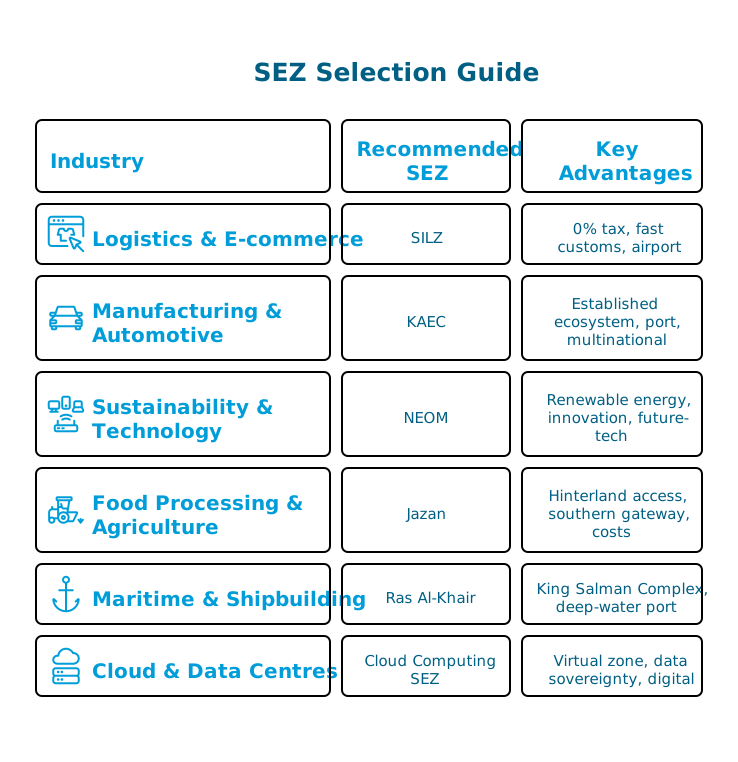
Setting up in a Saudi Arabian SEZ typically takes 2-3 months from start to finish with proper planning and documentation. Here's the standard timeline:
Phase 1: Pre-Setup Preparation (Weeks 1-2)
- Gather parent company documents and corporate approvals
- Draft comprehensive business plan
- Prepare financial statements for submission
- Initial ECZA consultation
Phase 2: MISA Investment Licensing (Weeks 3-6)
- Submit MISA application with supporting documentation
- ECZA coordination and review
- Licence approval received
Phase 3: Commercial Registration (Weeks 7-10)
- Ministry of Commerce registration
- Notarise articles of association
- Deposit minimum capital requirements
- Obtain commercial registration certificate
Phase 4: Post-Registration Compliance (Weeks 11-12)
- GOSI social insurance registration
- ZATCA tax registration (TRN)
- Customs registration if needed
- Sector-specific licences
Cost Considerations: MISA investment licence, commercial registration fees, legal and consultancy services, plus facility lease costs that vary significantly by zone and size requirements. Use the business setup cost calculator to estimate your total investment based on your specific requirements.
Other Economic Zones: Quick Reference
Whilst SEZs offer the best tax advantages, it's worth understanding Saudi Arabia's broader economic zone landscape. Beyond the six designated SEZs, the Kingdom operates industrial cities with different governance and no SEZ tax benefits.
SPARK Energy Park (Dammam): Energy-focused zone in Eastern Province. Mainland tax (20%) with no SEZ benefits. Relevant for energy sector businesses needing Eastern Province presence.
Jubail Industrial City: World's largest petrochemical complex in Eastern Province. Royal Commission governance, 20% mainland tax, no SEZ designation. Suits petrochemical manufacturers, heavy industry, and Saudi Aramco suppliers.
Yanbu Industrial City: Industrial zone on Red Sea coast. Royal Commission governance, 20% mainland tax. Suits petrochemicals, refining, and export manufacturing requiring Red Sea port access.
Decision Guidance is straightforward. Choose official SEZs for tax optimisation (5-0%), 100% foreign ownership, Saudisation flexibility, and ECZA support. Consider other zones for petrochemicals-energy requirements, established infrastructure over tax savings, or Saudi Aramco relationships.
Frequently Asked Questions
Let's address the critical questions you're likely asking about Saudi Arabia's Special Economic Zones.
Choose mainland for direct domestic market access, service operations across cities, lower initial costs, or local partnerships. Choose SEZ in KSA for export-focused operations, tax optimisation (5-0% versus 20%), 100% foreign ownership, employment flexibility, and ECZA streamlining. Hybrid approach for mainland vs SEZ in Saudi Arabia: manufacturing in SEZs, mainland sales offices.
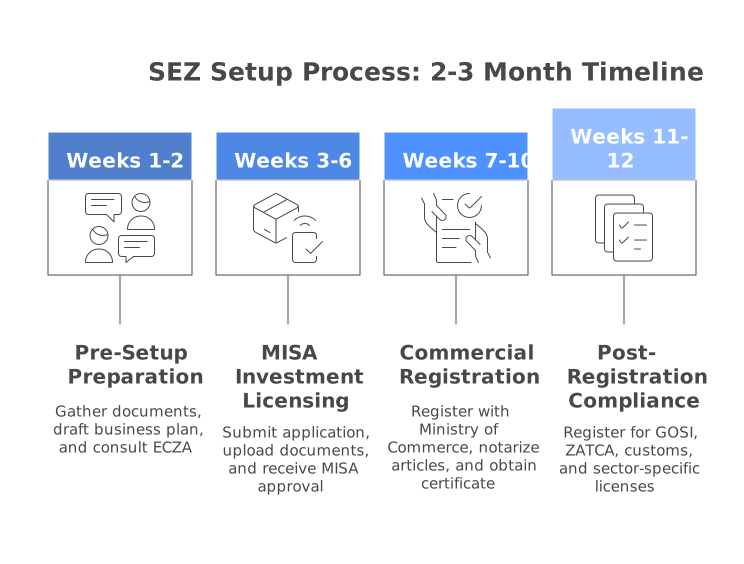
Manufacturing/automotive: KAEC (port access, multinationals). Logistics/e-commerce: SILZ (0% tax, 2-hour customs). Sustainability/tech: NEOM (renewable energy, innovation). Food/agriculture: Jazan (agricultural access, southern markets). Maritime: Ras Al-Khair (shipbuilding). Cloud/data centres: Cloud SEZ (virtual zone).
Mainland operations pay 20% corporate tax annually. Standard SEZs pay just 5% for 20 years—delivering 75% tax savings on corporate income. SILZ offers complete tax exemption at 0% for 50 years on qualifying logistics operations. Additional benefits include 0% withholding tax on profit repatriation, 0% VAT on intra-zone transactions, and complete expat levy exemptions. Over a 10-20 year horizon, these compounding savings represent substantial financial advantages for qualifying operations.
SILZ offers 0% corporate tax for 50 years on logistics (warehousing, distribution, e-commerce, supply chain). Other SEZs charge 5% for 20 years. The 0% rate applies specifically to qualifying logistics activities; manufacturing operations receive different tax treatment. SILZ remains the most tax-advantageous option for qualifying logistics operations.
The complete setup process typically takes 2-3 months through four distinct phases. See the dedicated "Setting Up in a Special Economic Zone: Timeline & Process" section above for the complete timeline breakdown including pre-setup preparation, MISA licensing, commercial registration, and post-registration compliance. Cost estimates vary by zone and business complexity—use the business setup cost calculator for personalised projections.
ECZA (Economic Cities and Special Zones Authority) functions as the One-Stop-Shop for all SEZ licensing, approvals, and ongoing support. ECZA provides centralised services replacing multi-agency navigation, fast-track processing, and simplified documentation requirements. Early engagement with ECZA helps you understand zone-specific requirements and expedite approvals.
Yes, though each location requires separate licensing. Companies can establish entities in multiple SEZs—for example, manufacturing in KAEC paired with logistics in SILZ. Consider administrative complexity, compliance requirements for each zone, and whether strategic benefits justify operational overhead. Multi-zone strategies suit larger operations with genuinely different activities benefiting from specialised infrastructure.
Foreign investors receive substantial protections under Saudi Arabia's enhanced investment framework: protection against expropriation without fair compensation, freedom to repatriate profits with 0% withholding tax, intellectual property protection under Saudi law and international treaties, access to arbitration and mediation with NEOM featuring dedicated arbitration centres, equal treatment with domestic investors, and dispute resolution mechanisms. These protections extend to all SEZ operations.
SEZs offer strong employment flexibility. Years 1-5 require 0% Saudi nationals—complete hiring flexibility. Years 6-10 require 15% minimum Saudi nationals. Post-10 years, standard mainland quotas may apply. Compare this to mainland operations facing 25-33% Saudisation from day one. Check the staffing calculator to plan your workforce requirements. Expat levy is fully exempted in SEZs, delivering substantial monthly cost savings per foreign employee. This flexibility proves invaluable during startup and growth phases.
Yes, during the first five years with 0% Saudisation requirements. Visas process through SEZ frameworks. After year five, you'll need 15% Saudi nationals in your workforce. Combining SEZ operations with RHQ status provides unlimited visas for the RHQ entity (separate from SEZ entity requirements). The expat levy exemption in SEZs delivers substantial monthly savings per employee—particularly valuable for operations employing dozens or hundreds of expatriate staff.
Yes, with specific conditions. Domestic sales may trigger customs duties and VAT, whilst certain SEZ benefits apply primarily to export-oriented activities. SEZs deliver optimal advantages for primarily export-focused businesses. Many companies pursue hybrid strategies: SEZ entities handle manufacturing and exports capturing tax benefits, paired with separate mainland entities handling domestic sales and distribution. Consult ECZA regarding specific activity permissions and domestic market access rules for your sector.
After 20 years (50 years for SILZ), your operation reverts to standard 20% mainland tax rates. Saudisation requirements increase to mainland levels. You can restructure your operations, relocate to alternative incentive programmes if available, or continue operations under standard terms. Planning should begin 3-5 years before expiration. Exit strategies and post-incentive scenarios merit consideration during initial setup to avoid surprises decades later.
Cloud Computing SEZ suits immediate setup with virtual zone flexibility, established regulatory frameworks, and specific focus on data centres and cloud infrastructure. NEOM suits long-term planning with future infrastructure development, sustainability focus, and phased timelines across multiple development areas. For data centres and cloud infrastructure operations starting now, choose Cloud Computing SEZ. For AI, biotech, or innovation businesses aligned with sustainability priorities and comfortable with development timelines, choose NEOM.
SILZ offers 0% tax versus KAEC's 5%—an additional 5% annual savings. SILZ provides airport integration versus KAEC's seaport (choose based on cargo mode). SILZ delivers two-hour customs clearance optimised for e-commerce. SILZ's 50-year incentive period doubles KAEC's 20 years. SILZ features dedicated e-commerce and parcel infrastructure. Choose KAEC if you require seaport access for containerised cargo or want manufacturing integration alongside logistics operations.
UAE free zones offer 0% tax across all zones, mature ecosystems with established business communities, and proven infrastructure developed over decades. Saudi SEZs counter with longer incentive periods spanning 20-50 years versus renewable UAE frameworks, larger domestic market access potential, strategic sector focus backed by substantial government investment, RHQ programme synergies unavailable in UAE, and Vision 2030 funding commitments. Choose UAE for services and financial operations benefiting from mature ecosystems. Choose Saudi SEZs for manufacturing and logistics operations with regional strategies leveraging domestic market potential.
Absolutely—this represents the optimal strategy for maximum tax efficiency. Establish your SEZ entity paying 5% or 0% tax on operations, obtain separate RHQ status paying 0% tax on regional management activities, and achieve blended effective tax rates below 5% across your corporate group. This requires proper legal structuring, transfer pricing compliance, and coordination between ECZA and MISA. Most implementations achieve ROI within 12-18 months, with subsequent years generating substantial tax savings. Combining SEZ operations with Regional Headquarters status creates blended effective tax rates below 5% for up to 30 years—a competitive advantage unavailable in UAE free zones or alternative regional structures.
Required documents include parent company incorporation certificate and bylaws, audited financial statements covering three years, comprehensive business plan detailing SEZ activities, passport copies of shareholders and managers, board resolution authorising Saudi establishment, no objection certificate if applicable, sector-specific licences for regulated activities, and bank reference letters. Requirements vary slightly by zone—confirm specifics with ECZA. Gather documents during weeks 1-2 of your setup process for smooth progression.
Annual obligations include preparing financial statements, filing tax returns even with 0% or 5% rates, submitting ECZA annual reports, maintaining employment records and Saudisation tracking, completing customs declarations for goods movements, and meeting audit requirements per Saudi regulations. ECZA provides ongoing guidance and compliance support, making regulatory obligations manageable. Budget for accounting and compliance services as part of annual operating costs.
Mainland establishment excels for businesses prioritising direct domestic market access without customs clearance requirements. Service companies operating across multiple Saudi cities benefit from mainland flexibility, whilst businesses with local partnership opportunities can leverage Saudi networks and market knowledge. Lower initial setup costs and established commercial infrastructure make mainland attractive for companies with domestic-focused business models where market access outweighs tax optimisation priorities.
KAEC excels for automotive manufacturing and supply chain operations, consumer goods requiring port infrastructure, pharmaceuticals and medical technology, industrial equipment manufacturing, and logistics-intensive operations. The presence of over 100 established multinational companies creates supplier ecosystems and partnership opportunities unavailable in newer zones. Manufacturing operations requiring immediate Red Sea port access with established handling capabilities find KAEC particularly advantageous.
NEOM offers dedicated arbitration centres providing enhanced dispute resolution mechanisms unavailable in other zones. The 100% renewable energy mandate creates unique opportunities for businesses requiring verifiable sustainability credentials. Development spans multiple mega-projects—The Line, OXAGON, Sindalah, Trojena—each targeting distinct industries with phased infrastructure delivery. NEOM prioritises future technologies and innovation over traditional manufacturing, attracting businesses aligned with cutting-edge development rather than immediate operational deployment.
SILZ primarily targets logistics, warehousing, distribution, e-commerce fulfilment, and supply chain operations. Light assembly and packaging activities qualify for certain incentives. However, SILZ's 0% tax applies specifically to qualifying logistics activities—manufacturing operations receive different treatment and tax structures. Companies requiring heavy manufacturing should evaluate KAEC, NEOM, or Jazan. SILZ remains unmatched for pure logistics and distribution operations prioritising maximum tax efficiency with air cargo connectivity.
Jazan provides direct access to Saudi Arabia's agricultural hinterland, reducing raw material transport costs for food processing operations. Cold chain infrastructure with temperature-controlled facilities supports perishables handling. LEED Platinum sustainability certification appeals to businesses with environmental commitments. The southern gateway positioning provides competitive access to East African markets and Yemen through strategic Red Sea location. Competitive real estate and operational costs versus western coast alternatives create total cost advantages for agricultural value-added production.
After the initial 20-year incentive period expires (50 years for SILZ), operations typically revert to standard mainland tax rates of 20%. Saudi Arabia has not announced automatic renewal mechanisms for SEZ tax incentives. Businesses should plan for this transition 3-5 years before expiration, evaluating whether to continue operations under standard rates, restructure corporate arrangements, or explore alternative incentive programmes available at that time. Exit strategies merit consideration during initial setup to avoid surprises when incentive periods conclude.
ECZA offers ongoing support including regulatory guidance updates, compliance assistance, coordination with other government entities, conflict resolution between investors and authorities, networking opportunities with other SEZ companies, infrastructure development coordination, and dedicated account management for larger investments. ECZA serves as single point of contact eliminating the need to work with multiple disconnected government agencies. This centralised support structure distinguishes SEZs from mainland operations requiring multi-agency navigation.
Glossary
Saudi Arabia Special Economic Zones - Key Terms
Essential terminology for navigating Saudi Arabia's Special Economic Zones framework
Regulatory body established to govern and promote Saudi Arabia's Special Economic Zones. ECZA provides One-Stop-Shop services handling SEZ licensing, approvals, and investor support through centralised coordination, serving as the primary contact point for all SEZ-related matters.
Designated geographic areas with special tax incentives, regulatory frameworks, and business benefits designed to attract foreign investment. Saudi Arabia operates six operational SEZs: KAEC, NEOM, SILZ, Jazan Economic City, Ras Al-Khair, and Cloud Computing SEZ.
Government entity responsible for investment licences and foreign investor facilitation. MISA works alongside ECZA for SEZ-specific licensing under the enhanced investment framework, coordinating investment approvals and business establishment procedures.
Saudi government policy requiring companies to employ minimum percentages of Saudi nationals. SEZs offer substantial exemptions: 0% requirement years 1-5, 15% requirement years 6-10, compared to 25-33% mainland requirements from day one.
Saudi Arabia's first operational SEZ, offering exceptional 0% corporate tax for 50 years on qualifying logistics activities. Located at King Khalid International Airport in Riyadh, SILZ represents the Kingdom's most tax-advantageous location for logistics operations.
185 square kilometre SEZ in Makkah Province focused on manufacturing, automotive, and logistics operations. KAEC features King Abdullah Port and hosts over 100 multinational companies with established infrastructure and proven operational track record.
Massive 26,500 square kilometre SEZ on Red Sea coast focused on sustainability, innovation, and future technologies. NEOM includes multiple projects—The Line, OXAGON, Sindalah, Trojena—with 100% renewable energy mandate and cutting-edge infrastructure.
Saudi initiative offering 30-year tax exemption for companies establishing regional management operations coordinating activities across multiple countries. RHQ status can combine with SEZ operations for optimised tax structures with blended rates below 5%.
Company establishment in Saudi Arabia outside Special Economic Zones, subject to standard 20% corporate tax, full Saudisation requirements from day one, and sector-specific foreign ownership restrictions varying by industry.
Saudi tax authority responsible for corporate tax administration, VAT collection, customs operations, and zakat administration for both mainland entities and SEZ operations, ensuring compliance with tax regulations.
Monthly fees charged per foreign employee in mainland Saudi Arabia at SAR 400 per employee. SEZs fully exempt this levy, providing significant cost savings for operations employing substantial numbers of expatriate staff.
Tax on profit repatriation and cross-border payments. SEZs offer 0% withholding tax on profit repatriation versus standard mainland rates, enabling unrestricted capital movement and dividend distributions to foreign shareholders.
ECZA's centralised service platform providing streamlined licensing, approvals, and support services for SEZ investors through a single coordination point, eliminating the need to work with multiple government agencies independently.
Understanding the Saudi Market
Saudi Arabia sits at the crossroads of three continents—Asia, Africa, and Europe—making it a natural hub for regional and international trade. The Kingdom's strategic location on the Red Sea isn't just geography; it's opportunity. Couple that with Vision 2030's transformation agenda, and you're looking at an economy rapidly pivoting from oil dependency towards innovation, technology, and diversified growth.
Special Economic Zones sit right at the heart of this shift. They're designed to accelerate private sector growth, attract international capital, and nurture high-potential sectors like cloud computing services, electronics manufacturing, and ICT assembly. The Saudi government's pouring resources into infrastructure and digitalisation, creating an ecosystem where foreign investors can operate efficiently with strong regulatory support.
Here's what makes the market compelling: a young, tech-savvy population driving consumer demand, rising disposable incomes, and a government genuinely committed to making Saudi Arabia business-friendly. The Kingdom's increasing its Direct Foreign Investment contribution to GDP from 3.8% to 5.7%—real targets backed by policy reforms and streamlined establishment processes.
Companies that take time to understand the Saudi market—its regulatory nuances, cultural expectations, and sectoral priorities—position themselves to benefit from this economic transformation. Whether you're establishing operations in an SEZ or exploring broader opportunities, you'll find strong government backing, efficient digital platforms for licensing and approvals, and access to one of the region's most dynamic markets.
Government Support Framework
The Saudi government's approach to SEZ development goes beyond just creating zones—it's about building an entire support ecosystem to help foreign investors succeed.
The Ministry of Investment leads the charge, offering tailored incentives and benefits for companies establishing regional headquarters or significant operations. Their role extends beyond licensing; they're actively facilitating market entry, coordinating with other agencies, and ensuring investors get the guidance needed to navigate Saudi regulations effectively.
ECZA serves as your central contact for all SEZ operations. Think of them as the conductor of the orchestra—coordinating licensing, managing ongoing support, handling compliance queries, and ensuring you're not bouncing between multiple government departments. Their One-Stop-Shop model genuinely simplifies what could otherwise be a bureaucratic maze. ECZA's mandate is straightforward: create a safe, modern, efficient business environment with special commercial regulations that actually benefit investors.
Other agencies work in tandem with these leads. The Saudi Arabian General Investment Authority collaborates on foreign investment attraction, whilst various sectoral regulators ensure industry-specific requirements stay manageable. The collective aim? Making it genuinely attractive for international businesses to invest, operate, and grow in Saudi Arabia whilst contributing to the Kingdom's economic development goals.
What's genuinely helpful here is that these agencies coordinate with each other. You're not dealing with conflicting requirements or duplicated processes. The reforms implemented over recent years have strengthened this collaborative approach, ensuring regulatory clarity, offering tax incentives where they make sense, and providing dedicated support programmes that respond to investor needs rather than just bureaucratic requirements.
Making Your SEZ Decision: Strategic Framework
Saudi Arabia's Special Economic Zones offer compelling opportunities for foreign investors, strengthened by Vision 2030's commitment and enhanced investment protections. With substantial foreign investment already committed and thousands of jobs created, SEZs demonstrate substantial market confidence and proven viability across multiple sectors.
Your strategic decision between mainland and SEZ establishment—or a hybrid approach combining both—depends entirely on your specific business model and priorities.
SILZ suits logistics operations seeking maximum tax optimisation with 0% rates for 50 years. KAEC works best for manufacturing operations requiring port access and established multinational ecosystems. NEOM attracts sustainability-focused innovation aligned with future technologies and renewable energy mandates.
Jazan serves food processing or industrial operations targeting Africa and regional markets through its southern positioning. Specialised SEZs—Ras Al-Khair for maritime operations or Cloud Computing for digital infrastructure—excel when sector-specific advantages matter most. Mainland establishment remains the right choice if domestic market access represents your primary objective and tax efficiency proves secondary to market penetration.
The RHQ multiplier effect creates exceptional opportunities for sophisticated investors. Combining SEZ operations with Regional Headquarters status delivers blended effective tax rates below 5% for up to 30 years—a competitive advantage unavailable in UAE free zones or alternative regional structures. SILZ paired with RHQ status achieves complete 0% tax exemption across both entities, creating unmatched tax efficiency for qualifying operations.
Your implementation roadmap starts with assessing sector fit against each SEZ's specialisation and infrastructure. Calculate tax savings over 10-20 year horizons to quantify financial benefits. Engage ECZA early for zone-specific guidance and expedited processing. Consider RHQ combination strategies for optimal tax structures. Consult legal and tax advisors for proper structuring, transfer pricing compliance, and ongoing regulatory coordination.
The opportunity is substantial. Enhanced investment protections, ECZA's One-Stop-Shop streamlining processes, ongoing infrastructure investments, and proven track records position Saudi Arabia's Special Economic Zones as compelling options for businesses seeking tax-efficient regional expansion. SEZs in KSA demonstrably offer advantages—your task is determining which configuration aligns with your strategic objectives and operational requirements.
Listen Audio
Related Resources
-
Business Setup in Saudi Arabia
Step-by-step support for company formation, licensing, and compliance. -
Business Setup in Saudi Arabia
Step-by-step support for company formation, licensing, and compliance. -
Business Setup in Saudi Arabia
Step-by-step support for company formation, licensing, and compliance.
Ready to Start Your Saudi Business Journey?
Talk to our experts and get step-by-step guidance on setup, compliance, and growth in KSA.